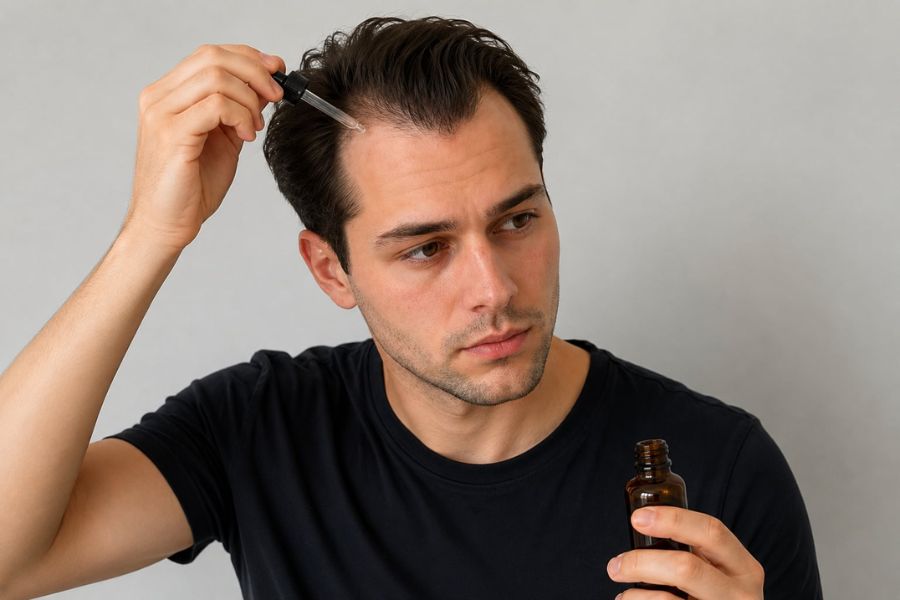
Yes, minoxidil can work for a receding hairline. It works better on the crown than at the hairline, though. It is officially approved only for the top of the scalp, so using it at the hairline is technically off label. Even so, several studies have found real improvement at the front of the scalp too, especially when someone starts treatment while the follicles are still thin, not fully gone.
If your hairline is creeping back at the temples, this guide is for you. You will learn why the hairline behaves differently than the crown, what the research actually says, how long minoxidil takes to work, and what to do if it stops helping. We will also cover how hairline thinning shows up differently in women, since most articles skip that part.
✔ Key Takeaways
- Minoxidil can slow or partly reverse a receding hairline.
- It works better on the crown than at the front of the scalp.
- Results at the hairline usually take three to six months to show, with the biggest changes around one year.
- The small 2015 study most articles quote had only 16 people in it, so treat the big numbers with some caution.
- Women can use minoxidil on a thinning hairline too, though the cause is often different from male pattern hair loss.
- Minoxidil cannot regrow hair where the follicle has fully stopped working. It needs at least a thin strand still coming through.
Does Minoxidil Work for a Receding Hairline?
Minoxidil can help a receding hairline. The results are usually smaller than what people see at the crown. Minoxidil is a topical medication that widens blood vessels in the scalp. This pushes hair follicles into a longer growth phase. It started out as a blood pressure drug in the 1970s. Researchers noticed hair growth as a side effect, and it became a hair loss treatment soon after.
The FDA approved label for minoxidil only covers the top of the scalp. It does not officially cover the hairline. That does not mean it fails there. It means the original trials focused on the crown. Since then, smaller studies have tested the hairline directly, and most found real improvement, just less than at the crown.
What Causes a Receding Hairline
A receding hairline is usually caused by androgenetic alopecia, a genetic sensitivity to a hormone called DHT. DHT slowly shrinks hair follicles over time, a process called miniaturization. Thick hairs turn into short, thin ones. In men, this often starts at the temples and crown first, creating the classic M shaped hairline.
Non genetic causes, including traction alopecia in women
Women get hairline thinning too, but the pattern is often different. A 2025 review in Frontiers in Pharmacology notes that female pattern hair loss usually shows up as a widening part, with the hairline itself mostly staying intact. A true receding hairline in a woman is more often linked to other causes. Traction alopecia is one of the most common. It comes from tight ponytails, buns, braids, or extensions. Postpartum shedding and thyroid changes can also thin the hairline for a while.
What Stage of Hair Loss You Are Working With
Your stage of hair loss decides how much minoxidil can realistically help. Doctors use the Norwood scale for men and the Ludwig scale for women. Knowing your stage sets the right expectations.
Norwood stages for men
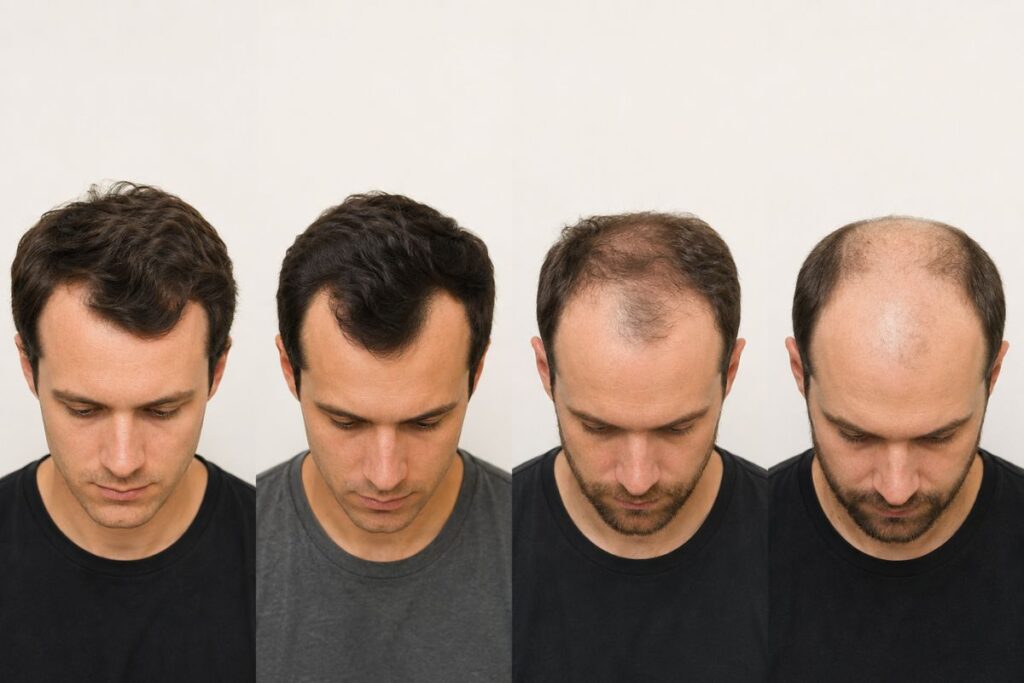
Stages one and two show only slight temple recession with plenty of hair left. Minoxidil tends to work well here, since follicles are just starting to shrink. Stages three and four show a clearer receding hairline, sometimes with crown thinning too. Minoxidil can still help, though full regrowth becomes less likely. By stage five and beyond, large areas are smooth and shiny, meaning most follicles there have closed for good, so minoxidil rarely helps.
Ludwig stages for women
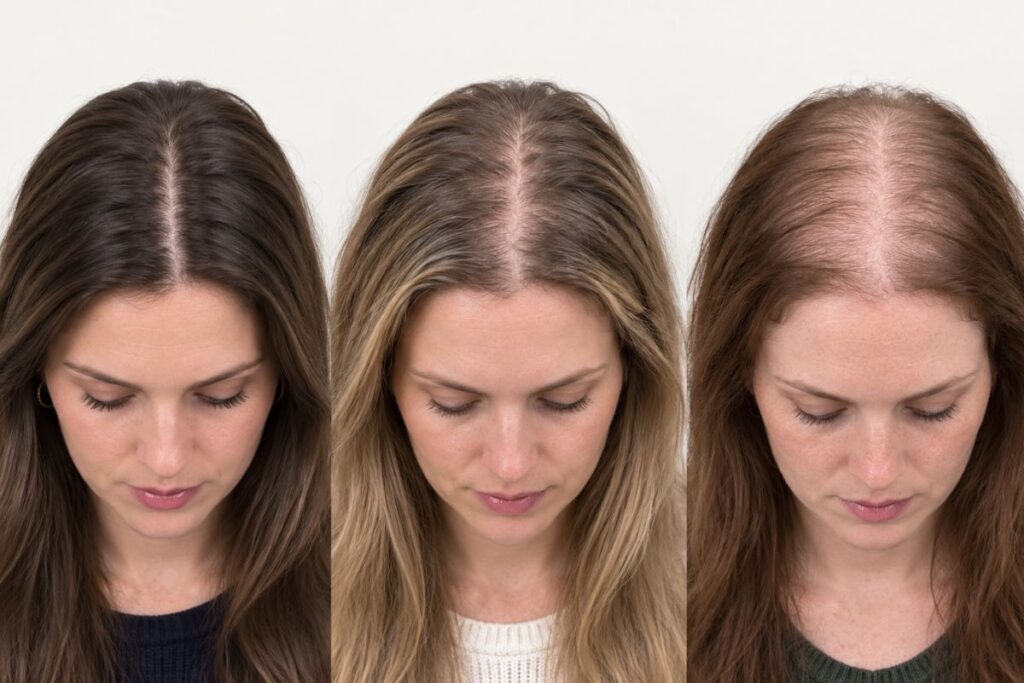
The Ludwig scale describes a widening part and overall thinning, not sharp hairline recession. Stage one shows mild part widening, stage two shows more visible scalp, and stage three shows large areas of see through thinning. Minoxidil helps most in stages one and two, when follicles are thin but still active.
A simple self check
Look closely at the thinning area in good light. Fine, short, or wispy hairs still growing there means minoxidil has something to work with. Skin that is completely smooth with no hair at all means minoxidil is unlikely to bring hair back to that spot.
Why the Hairline Responds Differently Than the Crown
The hairline tends to respond less than the crown because frontal and temple follicles often carry more androgen receptors. This makes them more sensitive to DHT, so they miniaturize faster and are harder to reverse.
A 2015 study in the British Journal of Dermatology compared gene activity in the crown and the frontal scalp and found broadly similar biological responses in both areas. Even so, visible regrowth in real world use still tends to favor the crown. One way to picture it is a tug of war. Minoxidil pulls the same way everywhere on the scalp. The hairline just has a stronger opponent pulling back.
What the Research Actually Shows
The research on minoxidil and the hairline is thinner than most blogs suggest. Many competitor articles repeat one small study, the same 16 participant trial mentioned above. It is real, peer reviewed research. A sample that small still deserves some caution before you treat it as settled proof.
Larger studies fill in more of the picture. One 104 week trial followed men using 5 percent minoxidil foam. Density stayed fairly stable overall at both the crown and the hairline, but the early gains seen at the frontal hairline specifically faded back closer to baseline by the end of the study. In plain terms, minoxidil seems better at protecting the hairline you still have than at growing back hair that has been gone a long time.
A separate trial gives useful numbers on strength. Researchers compared 5 percent and 2 percent minoxidil in 393 men over 48 weeks. The 5 percent version produced 45 percent more regrowth than the 2 percent version. That is part of why dermatologists usually recommend the stronger formula.
Combination therapy has stronger evidence behind it. A meta analysis of seven trials found that pairing minoxidil with finasteride produced better density and thickness than minoxidil used alone. A separate study followed men using oral minoxidil with finasteride for 12 months, and 92.4 percent had stable or improved hair by the end. That is a meaningful gap compared with using minoxidil by itself.
Crown vs Hairline: How Minoxidil Compares
| Category | Crown | Frontal Hairline |
| FDA approved for this area | Yes | No, considered off label use |
| Typical response rate | Higher, more consistent | Lower, more variable |
| Time to see initial change | 3 to 4 months | 3 to 6 months |
| Realistic long term goal | Regrowth and density gain | Mostly slowing loss, with some partial regrowth |
| Follicle sensitivity to DHT | Lower | Higher |
How Long Minoxidil Takes to Work on the Hairline
Minoxidil usually takes three to six months to show visible change at the hairline. Peak results tend to show up around nine to twelve months of steady use. The first four to six weeks often bring extra shedding. This feels alarming, but it is normal. Older, weak hairs are pushed out so newer, thicker hairs can take their place.
If you stop using minoxidil, that progress usually fades. The product labeling is direct about this, stating that regrown hair typically sheds again within a few months of stopping. Minoxidil does not change your genetics or hormone levels, so it has to be used continuously to keep working.
How to Apply Minoxidil to the Hairline Correctly
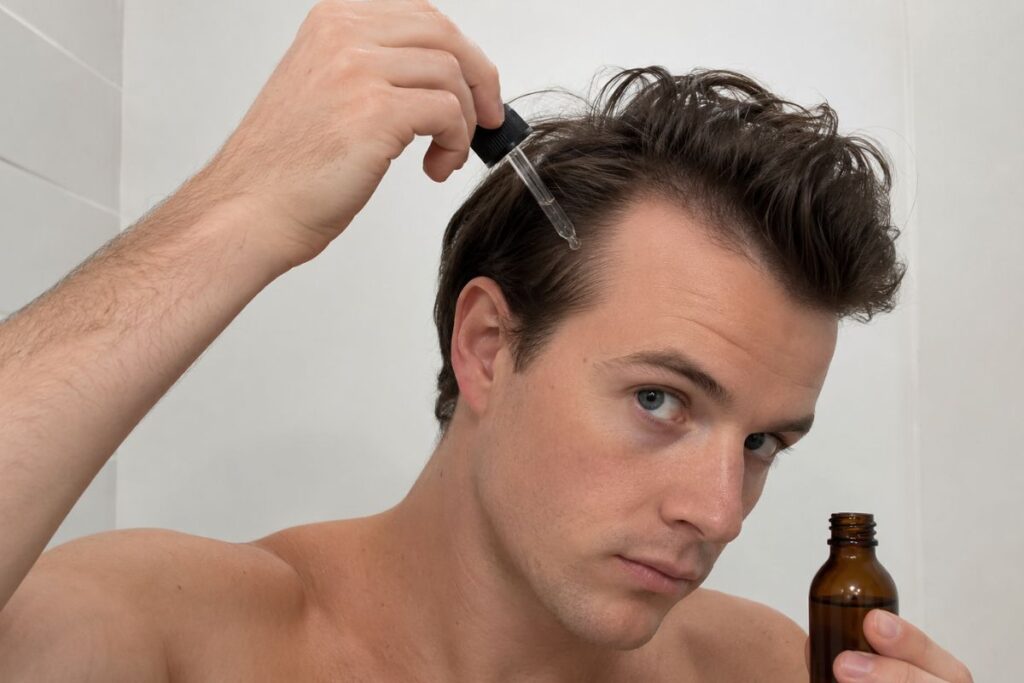
Prepping a dry scalp and sectioning hair
Start with a completely dry scalp. Wet skin dilutes the solution. Part your hair along the thinning area first, so the product touches skin, not just hair strands.
The application steps
Step 1: Start with a dry scalp.
Step 2: Part your hair so the product reaches skin directly.
Step 3: Apply about one milliliter of solution, or half a capful of foam, along the hairline.
Step 4: Massage it in gently for about thirty seconds.
Step 5: Wait at least four hours before washing your hair or lying down.
Step 6: Wash your hands right after every application.
Step 7: Repeat this twice a day, about twelve hours apart.
Foam versus liquid at the hairline
Foam tends to be easier to control at the hairline than liquid. Liquid can run down toward the forehead and eyes, while foam stays in place better along that edge.
Brand name versus generic, does Rogaine or Kirkland make a real difference
Rogaine, Kirkland Signature, and other generic 5 percent minoxidil products all use the same active ingredient at the same strength. The brand itself does not change how well it works. The real differences come down to extra ingredients, like whether propylene glycol is included, and the price you pay.
| Product type | Active ingredient | Typical strength | Approx. USA price range | Best suited for |
| Rogaine brand foam | Minoxidil | 5 percent | 35 to 50 dollars per month | People who want a brand name |
| Kirkland generic solution | Minoxidil | 5 percent | 15 to 25 dollars per month | Budget conscious daily users |
| Generic pharmacy brand foam | Minoxidil | 5 percent | 20 to 30 dollars per month | Easy use at the hairline |
| Women’s minoxidil solution | Minoxidil | 2 percent | 20 to 30 dollars per month | Women wanting less facial hair risk |
| Oral low dose minoxidil | Minoxidil | Prescription only | Varies by provider | People who dislike topical use |
Does Kirkland minoxidil work for receding hairline treatment as well as Rogaine? Yes, it does, since it contains the same active ingredient at the same strength. Generic drugs are required to match the original in strength and performance, which is why the main difference between brands usually comes down to extra ingredients, along with how the foam or liquid feels on your scalp.
Side Effects, Shedding, and What Happens if You Stop
Minoxidil side effects are usually mild and mostly limited to the scalp. Common issues include itching, dryness, flaking, and redness, and these typically improve on their own as your scalp adjusts to the product.
Less common side effects include unwanted hair growth on the face or hands if the product spreads there by accident. Rare side effects include a fast heartbeat or swelling, which show up more with oral minoxidil than with topical use. If you have a heart condition, talk to a doctor first, since minoxidil can interact with some blood pressure medications.
Does minoxidil change hair texture permanently
Usually, no. Some people notice their new hair feels finer or coarser at first, which often reflects the natural texture of a follicle that is still recovering rather than a permanent change. As the follicle settles into a steady growth pattern, texture generally evens out over time.
Does minoxidil cause hair fall after stopping to use it
Yes, in most cases. Regrown hair depends on minoxidil to stay in its growth phase, so stopping treatment usually causes that hair to shed within a few months. This is not damage. The follicle is simply returning to the pattern it would follow without the drug.
When Minoxidil Alone Is Not Enough
Minoxidil stops helping once follicles have been fully dormant for years. It also will not work if the real cause is not androgenetic alopecia at all, such as advanced traction alopecia with scarring or frontal fibrosing alopecia. Watch for these signs: no change after a full year of correct use, thinning that keeps getting worse anyway, or an area that was already bald before you started.
Combining minoxidil with finasteride or dutasteride
Finasteride lowers DHT in the body while minoxidil keeps follicles growing, so together they cover more ground than either alone. The same meta analysis mentioned earlier found that combining the two produced significantly better density and thickness than minoxidil alone, especially at the hairline.
Supporting habits and adjuncts
Microneedling and ketoconazole shampoo can support absorption and scalp health. Enough protein, iron, zinc, and vitamin D helps too, along with a gentle sulfate free shampoo, regular scalp massage, and quitting smoking. None of these replace minoxidil, but they support the results it gives you.
Other options once minoxidil hits its ceiling
If minoxidil and finasteride still are not enough after a year, low level laser therapy, PRP, or a hair transplant are worth discussing with a dermatologist, especially if the cause turns out to be something other than typical genetic thinning. A transplant is currently the only option that restores density in an area that has been bald for a long time.
Frequently asked questions
Does minoxidil work for receding hairline male pattern baldness specifically?
Yes, it does. Minoxidil is a well established treatment for this type of hair loss. It works best in the early stages, when follicles are thin but still active. Results at the hairline are usually slower than at the crown.
Does minoxidil work on hairline for women in the same way it does for men?
Yes, it can help women too. Female hairline thinning often looks like a widening part rather than sharp recession. Women usually use a lower strength formula. Results follow a similar timeline for early change.
Does Rogaine work for receding hairline treatment better than generic minoxidil?
No, they work the same way. Rogaine and generic minoxidil share the same active ingredient at the same strength. Generic versions have to meet the same standards as the brand name. Price is usually the only real difference.
Does minoxidil work for thinning hair across the whole scalp, not just the hairline?
Yes, it does. Minoxidil was first studied mainly for crown thinning, and it often works even better there than at the hairline. Many users see faster results on the crown than at the front.
Does minoxidil grow new hair follicles or only support existing ones?
It only supports existing follicles. Minoxidil does not create brand new ones. It helps shrunken follicles grow bigger again, which makes hair look thicker over time.
Is minoxidil good for hair overall, beyond just treating a receding hairline?
Yes, it is. Minoxidil is one of the two most proven treatments for genetic hair thinning, alongside finasteride. It can improve density and thickness when used daily for several months.
I have used minoxidil on my hairline for about seven months and I see a little fuzz but nothing dramatic. Is this working or should I stop?
This is likely a good early sign. Fine fuzz after several months often means the treatment is working. Full hairline results can take nine to twelve months to show clearly. It is worth continuing for a few more months before deciding it has failed.
I am twenty six and just noticed my hairline moving back at the temples. Is it too early to start minoxidil, or should I wait and see?
Starting now is actually the ideal time. Minoxidil works best on follicles that are just starting to shrink. Waiting years while the thinning gets worse makes results harder to reach. Early, steady use tends to give the best long term outcome.
Conclusion
So, does minoxidil work for a receding hairline? Yes, with real limits. It can slow the process, and for many people who start early, it can bring back some real thickness at the front too. It just does not work as reliably there as it does on the crown, and it cannot revive follicles that stopped working long ago.
Remember three things. Start early, while thin hair is still present. Stay consistent, since results build slowly over months. Consider pairing minoxidil with a DHT blocker if your hair loss is genetic. If you are unsure what is causing your hair loss, a dermatologist can confirm it before you spend months on one treatment.