✔ Key Takeaways
- Low porosity hair has a tight, flat cuticle. It resists moisture.
- High porosity hair has a lifted or damaged cuticle. It absorbs moisture fast and loses it just as fast.
- The float test is popular. But some hair chemists now call it unreliable.
- Curly and coily hair often runs more porous. Every bend in the strand lifts the cuticle a little.
- Neither porosity type is better or worse. Each one just needs different care.
- Heat above 311 degrees Fahrenheit starts breaking down keratin. That damage raises porosity over time.
Low porosity hair has a tight, flat cuticle. It keeps moisture out. High porosity hair has a lifted or damaged cuticle. It lets moisture in fast, then lets it escape just as fast. That difference is the whole story behind low porosity hair vs high porosity hair. It explains why your hair frizzes, dries in ten minutes, or takes half a day to feel damp.
Have you ever wondered why a product works great on your friend but does nothing for you? Porosity is usually the reason. This guide breaks down what porosity actually is. You will learn how to test it without guessing. You will learn why curly and coily hair often runs more porous. You will also learn what products truly help each type. And you will find out if the popular float test still holds up.
Low Porosity Hair vs High Porosity Hair
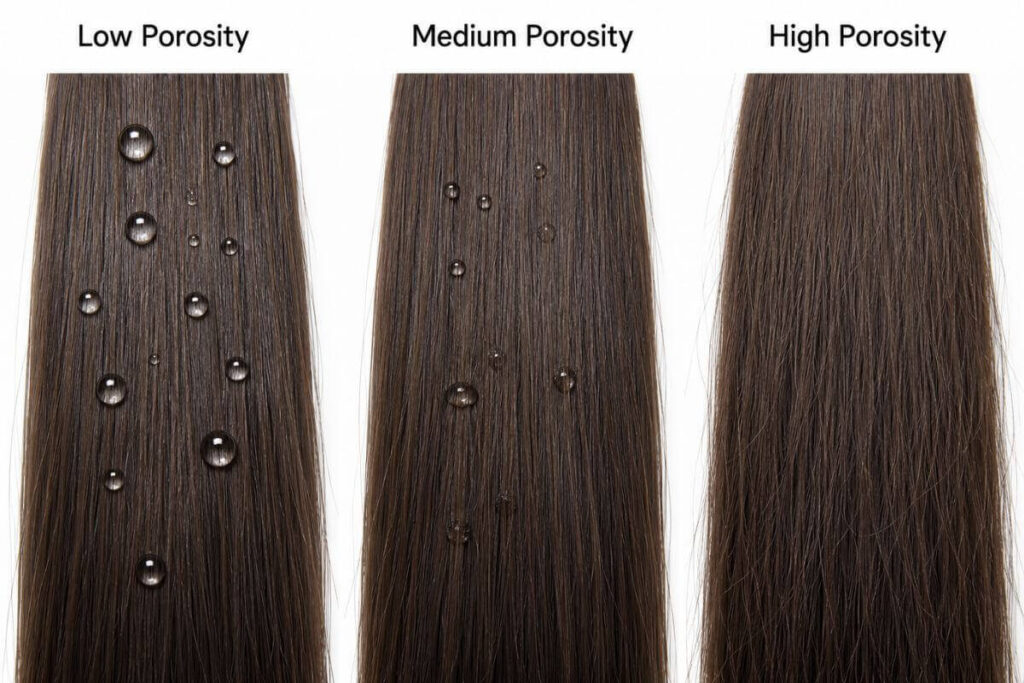
Low porosity hair resists moisture. The cuticle lies flat and tight against each strand. High porosity hair absorbs moisture fast. Then it loses that moisture just as fast. This happens because the cuticle sits lifted or chipped.
Think of the cuticle like shingles on a roof. Flat shingles let water slide off slowly. Lifted or cracked shingles let water rush in. Then it rushes right back out. That is porosity in one picture.
Which One Is Better?
Neither type is good or bad. They just behave differently. Each one needs its own routine. Low porosity hair holds color and style longer. High porosity hair processes treatments faster. The real goal is matching your care to the hair you actually have.
What Is Hair Porosity and What Causes It?
Hair porosity is how easily your hair absorbs and holds water. Your cuticle controls almost all of it. The cuticle is the protective outer layer wrapped around every strand.
Each hair fiber has three layers. The medulla sits at the very center. The cortex surrounds it. It holds most of your hair’s strength and color. The cuticle wraps around both. It is made of overlapping cells. Under a microscope, they look like shingles. Flat cells mean moisture moves in and out slowly and evenly. Lifted or cracked cells mean moisture rushes in, then escapes just as fast.
Genetics vs Damage: The Two Real Causes
Porosity comes from two places. Genetics sets your natural starting point. Some people are simply born with a tighter cuticle. Others are born with a looser one. Damage changes things from there. Heat styling lifts the cuticle. So do chemical treatments. So do sun exposure and harsh shampoos. All of them push porosity higher over time. This happens no matter where you started.
According to a 2016 review published in the journal Cosmetics, water measurably changes hair. Hair soaked in water gains 12 to 18 percent in weight. Its diameter can swell more than 15 percent. That swelling is completely normal on its own. The real problem is repetition. Swelling and drying over and over stresses the inner cortex.
The Full Hair Porosity Scale: Low, Medium, and High Explained
Porosity is not just low, medium, or high. Professional colorist training actually uses five specific grades. They range from completely untouched hair to hair that has lost nearly all its cuticle.
Grade one is virgin hair with almost no sun or weather exposure. It is extremely rare. It shows up mostly in straight hair. Grade two is still natural hair, but with some minor exposure. It is the most common grade for healthy, untouched hair. Grade three is hair lightened up to five shades. Its cuticle has started to open. Grade four is bleached hair, lightened up to seven shades. It needs real extra care since the cuticle stays open and loses moisture fast. Grade five has lost almost all cuticle protection. It feels gummy when wet. At this point, a trim is often the only real fix.
Grades one and two count as low porosity. Grade three sits in the medium range. Grades four and five count as high porosity.
Low vs Medium vs High Porosity: Full Comparison
| Porosity Type | Cuticle State | Moisture Behavior | Float Test Result | Best Product Texture | Common Cause |
| Low porosity | Flat, tightly packed | Slow to absorb, holds moisture once in | Floats near the top | Lightweight, water based | Genetics, mostly untouched hair |
| Medium porosity | Slightly open, balanced | Absorbs and keeps water reasonably well | Sinks slowly, settles in the middle | Balanced moisturizers, occasional protein | Mild sun or heat exposure |
| High porosity | Lifted, chipped, or gapped | Absorbs fast, loses moisture fast | Sinks quickly | Rich creams, sealing oils, protein treatments | Bleach, heat, chemical processing |
How to Test Your Hair Porosity: The Float Test vs Behavioral Signs
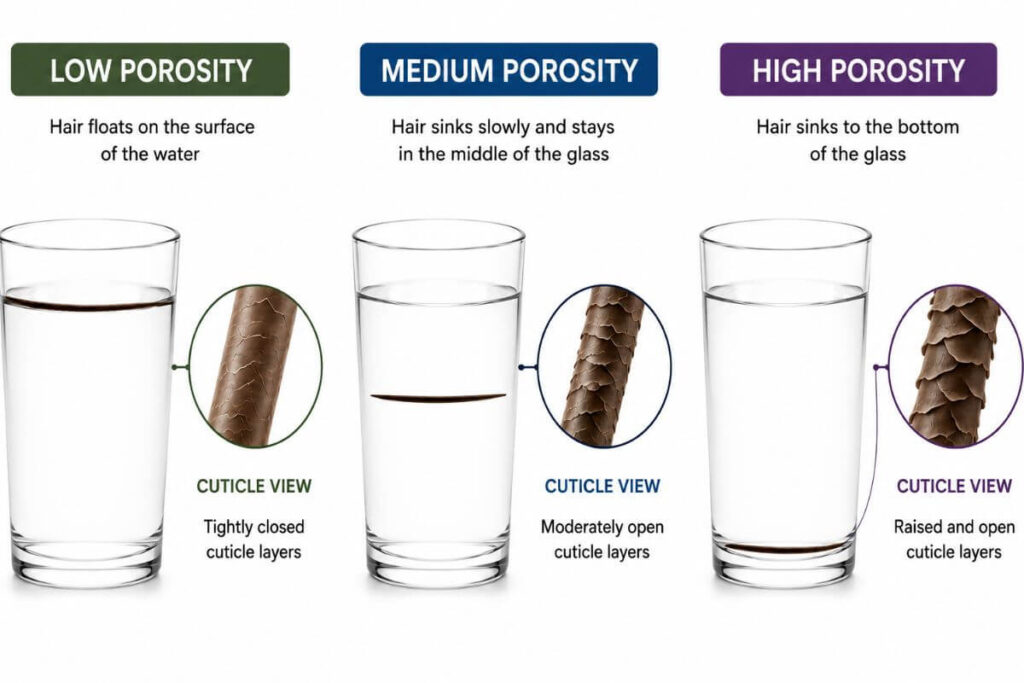
The float test gives you a rough idea of your porosity. But hair scientists increasingly point to real limits in how reliable it actually is.
The Float Test Step by Step
Step one, wash your hair. Let it air dry with no products on it. Step two, fill a glass with room temperature water. Step three, drop one clean strand into the glass. Wait a few minutes. If it sinks fast, that points to high porosity. If it floats near the top, that points to low porosity. If it sinks slowly and settles in the middle, that points to medium porosity.
Why Some Experts Question the Float Test
Not everyone trusts this test completely. Oil residue can throw off the result. So can leftover product. So can water temperature. A strand with invisible product buildup might float. That can happen even if your hair is actually quite porous underneath.
More Reliable Signs to Watch For
Pay attention to how your hair behaves day to day. Does it take more than ten minutes to feel fully wet in the shower? Does it air dry in under an hour? Does humidity turn your hair frizzy the second you step outside? High porosity hair usually dries fast. It frizzes easily too. Low porosity hair resists both water and product, no matter how long you wait.
Why Curly, Coily, and 4C Hair Tends Toward Higher Porosity
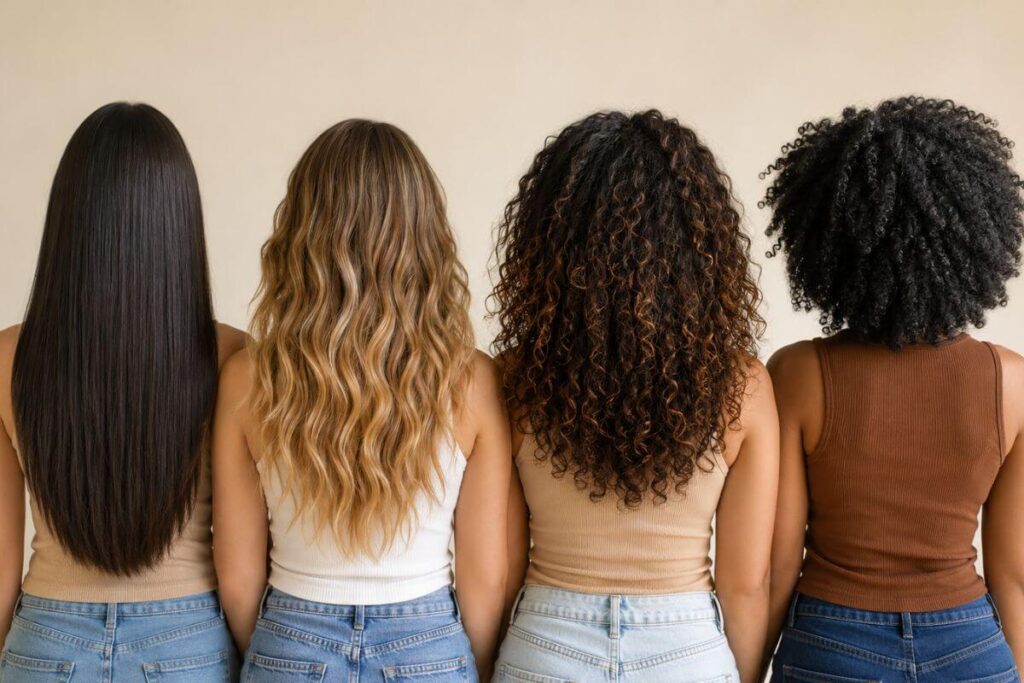
Curly, coily, and 4C hair often runs higher in porosity than straight hair. The curl itself is part of the reason why.
The Twist Point Mechanism
Every curl or coil has bend points along the strand. At each bend, the cuticle lifts just slightly. It cannot lie completely flat there. This happens just from the shape. It happens even before any heat or color touches the hair. The International Society of Hair Restoration Surgery confirms this pattern. African hair is more elliptical in cross section. It shows a wide range of shape variation. Research in the Journal of the American Academy of Dermatology backs this up further. That oval shape is programmed directly into the hair follicle. This oval shape is exactly why coily strands show more lifted points than round, straight hair does.
An Important Caveat
Not every expert agrees curl pattern is the whole story. Porosity is really about how permeable your cuticle is. It is not about texture alone. Two women can have the same curl pattern. They can still land on different points of the porosity scale. Genetics plays a role. So does styling history.
Is Low Porosity Hair or High Porosity Hair Better? The Real Pros and Cons
Neither porosity type wins outright. Each one carries real advantages. Each one carries real challenges too.
Low Porosity Hair: Advantages and Challenges
Low porosity hair tends to be shinier. A flat cuticle reflects light more evenly. It holds onto color and styling results longer. It also resists everyday damage better than more porous hair. But there are real tradeoffs. But getting moisture in is harder. Products tend to coat the surface rather than absorb. Hair can take a long time to dry after washing.
High Porosity Hair: Advantages and Challenges
High porosity hair absorbs treatments and color quickly. This makes chemical services faster. Results are often more dramatic too. Deep conditioners work fast, since the open cuticle lets them in easily. But moisture also leaves just as fast as it enters. That means more frizz. It means more breakage. Color sometimes turns out cooler than expected too.
What Causes Low Porosity Hair Specifically?
Low porosity hair usually comes from one of two places. Either your genetics, or product buildup that mimics the same symptoms.
Some hair types are simply born with a naturally tighter cuticle. This shows up more often in straight to wavy hair. But heavy product buildup can cause the exact same symptoms. It coats the hair’s surface so thoroughly that hair starts behaving like low porosity hair. This happens even if your natural cuticle is not actually that tight. That is exactly why a clarifying wash is worth trying first. Test it before you assume your hair is naturally low porosity.
How Heat, Chemical Treatment, and Washing Damage Porosity Over Time
Heat, chemical treatments, and washing habits can all push your natural porosity higher. Sometimes the damage is permanent.
Research on heat treatment of hair structure found a critical temperature. It sits around 140 degrees Celsius, or 284 degrees Fahrenheit. The exact threshold can vary a little from person to person. Below this point, changes stay reversible. They mostly come from moisture loss. Above it, structural changes become deep and permanent. A related PubMed study on flat ironing confirms this pattern too. Flat irons above 200 degrees Celsius cause real damage to hair keratin. Many home flat irons run at or above this range.
Bleaching and other chemical services work differently. They penetrate straight into the cortex. That process disrupts the cuticle. Sometimes just one treatment is enough. Sun exposure breaks down hair proteins and fats slowly over time. Harsh detergent shampoos strip hair aggressively too. Months of regular washing with these can compromise the cuticle.
There is also a slower process at work. It is called hygral fatigue. Every time your hair absorbs water, it swells. Every time it dries, it contracts. This cycle weakens the cuticle over time, a pattern confirmed in PubMed research on hair cuticle swelling. One wash will not destroy your hair. Hundreds of washes and dry cycles genuinely add up.
Best Products for Low, Medium, and High Porosity Hair
Matching your products to your actual porosity type makes the biggest difference in how your hair feels every day.
Low Porosity Hair Products
Choose lightweight, water based formulas. They will not sit heavily on the surface. Humectants like glycerin help pull moisture in. A weekly clarifying shampoo keeps buildup from making things worse. Skip heavy butters and thick oils. They usually just sit on top without absorbing.
Medium Porosity Hair Products
Medium porosity hair needs the least dramatic care of the three types. Look for moisturizing shampoos and conditioners. They should hydrate without weighing hair down. Add an occasional deep conditioning or light protein treatment. You do not need a strict weekly routine here.
High Porosity Hair Products
Reach for rich, moisturizing creams and butters. They seal in hydration once it gets in. Sealing oils help lock that moisture down further. PubMed research on oil films shows why this works. Oil films form a real barrier. That barrier slows moisture loss from the hair shaft. Regular deep conditioning and protein treatments matter too. They fill in the gaps left by a compromised cuticle.
Does the LOC Method Actually Work for High Porosity Hair?
The LOC method genuinely helps many women with high porosity hair. But the research on how much it actually improves moisture is more complicated than most product marketing suggests.
What the LOC and LCO Methods Are
LOC stands for liquid, oil, and cream, applied in that order. LCO swaps the last two steps. Both methods layer moisture into the hair. Then they seal it in before it can escape through a lifted cuticle.
What the Research Actually Says
Here is where things get interesting. Cosmetics and Toiletries covers research on this exact question. Relative humidity controls hair’s water content far more than daily conditioning does. How moisturized hair feels does not always match how much water is actually inside the strand. Part of the benefit from LOC may come from a better surface feel. It may not come from a real increase in water retention. That does not mean the method is useless. It just means the honest answer is more complicated than most brands admit.
Is Hair Porosity Permanent? Can You Fix It?
Some porosity damage cannot be undone. But you can slow further damage. You can also support the hair you are currently growing.
Once a section of cuticle chips away, it will not grow back on that part of the strand. That part of your hair stays permanently more porous. Still, what you do going forward matters a lot. Reducing heat exposure helps. So does limiting harsh chemical services. So does using gentler cleansers. All of this slows future damage. As damaged hair grows out and gets trimmed, new hair grows in behind it. Over time, that gives you a real chance at healthier average porosity.
Frizz vs Porosity: Why They Are Not the Same Thing
Frizz and porosity get confused all the time. But they describe two completely different things.
Frizz reflects what your hair does in real time. It shifts with weather, humidity, and whatever product you used that day. Porosity is the actual structural condition of your cuticle. It stays fairly consistent unless your hair takes on more damage. High porosity hair frizzes more easily, since its open cuticle reacts strongly to humidity. But frizz itself can come and go daily, even when your underlying porosity has not changed at all.
Can You Grow Low Porosity Hair Faster?
Porosity does not change how fast hair grows from the follicle. But it does affect how much of that length you actually keep.
Hair growth rate is a biological process happening at the scalp. Porosity has no direct effect on it. What porosity does affect is breakage. Healthier, well moisturized hair snaps less often. That means more of what you grow stays attached instead of ending up on your brush. For low porosity hair specifically, focus on three things. Detangle gently. Keep up consistent lightweight moisture. Minimize unnecessary heat. These three habits support length retention more than any growth product ever could.
Frequently Asked Questions
Is the float test accurate for checking hair porosity?
The float test gives a rough starting point. But it is not perfectly reliable. Oil residue, leftover product, and water temperature can all skew the result. Watching how your hair behaves day to day gives a clearer picture. That includes drying time and frizz in humidity.
Is low porosity hair good or bad?
Low porosity hair is not good or bad. It simply behaves differently. It holds color and style longer. It resists everyday damage well too. But it can be harder to moisturize. It is also more prone to product buildup on the surface.
What causes low porosity hair?
Low porosity hair usually comes from a naturally tighter, genetically inherited cuticle. Heavy product buildup can also mimic the same symptoms. That is why a clarifying wash is worth trying before assuming your hair is naturally low porosity.
What are the best products for high porosity hair?
High porosity hair does best with rich, moisturizing creams, sealing oils, and regular protein treatments. These ingredients fill gaps in the compromised cuticle. They also lock moisture in before it can escape.
Can hair porosity change over time?
Yes. Porosity can increase through repeated heat styling, chemical processing, and harsh washing habits. Genetic porosity stays fairly stable. But damage related porosity builds gradually. It can worsen with continued stress on the cuticle.
I have curly hair that has been colored and heat styled for years. Is my high porosity permanent damage, or can it improve if I stop processing my hair?
Some of that damage is likely permanent on the strands already affected. A chipped cuticle cannot grow back. Reducing heat and chemical processing will not reverse existing damage. But it will let healthier new growth replace it over time. That gradually improves your overall porosity.
I keep layering leave-in conditioner, oil, and cream on my hair because I read it helps high porosity hair retain moisture, but my hair still feels dry by the end of the day. Am I doing something wrong or does this method just not work for everyone?
You are not necessarily doing anything wrong. Some research suggests layering methods like LOC improve how hair feels more reliably than they improve actual measured moisture. Try a heavier sealing oil. Try reducing wash frequency slightly. Try adding a protein treatment. Any of these may help more than adding another liquid layer.
Conclusion
Low porosity hair vs high porosity hair really comes down to one thing. How your cuticle handles moisture. Low porosity resists water. It holds onto water once it finally gets in. High porosity welcomes water quickly. Then it lets that water go just as fast.
Remember three things. First, the float test is a decent starting point. But your hair’s actual daily behavior tells you more. Second, neither porosity type is better. Each just needs a different approach to products and care. Third, damage genuinely raises porosity over time. Protecting your cuticle now protects your options later.