
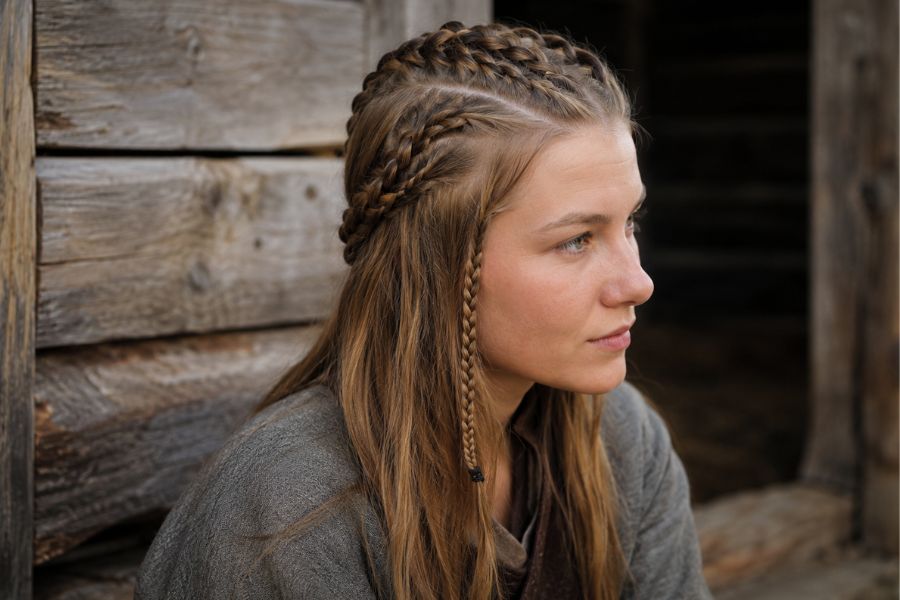
Almost everything we know about female Viking hairstyles comes from a short list of evidence. There are a few thumb-sized silver figures and a handful of silk headscarves from York, Dublin and Lincoln. There are also thousands of bone and antler combs, and poems written down long after the Viking Age ended. That list shows that long, well-kept hair mattered. It also shows that hair was often gathered into a knot or bun at the back of the head.
It does not support the shaved sides and busy braid patterns that TV made famous. Even braids are harder to confirm than most costume guides admit. Each style below has a note on how much history stands behind it. That way you can choose a look that stays close to the evidence or one that is simply fun to wear.
Key Takeaways
- Viking Age figurines show women with long hair gathered into knots, buns or ponytails; braids are plausible but harder to confirm.
- Thousands of decorated combs from Viking Age sites show that hair care mattered to Norse men and women.
- Many shaved side and elaborate undercut styles seen on TV have no real historical support.
- Silk headscarves and caps found in York and Dublin were costly imports that likely showed wealth. Why women wore them is still debated.
- You can recreate Viking-inspired braids at home, even with short or fine hair.
Female Viking Hairstyles
The short answer is long hair that was clearly cared for, usually gathered at the back of the head rather than shaved or cropped. Knots, buns and ponytails have the strongest support, because those are the shapes small silver and bronze figures actually show. Braids are a fair guess for long hair. But on objects only a few centimeters tall, they are hard to tell apart from a scarf or cap. This is a problem historians studying Viking Age finds in England have pointed out.
Why TV and History Tell Two Different Stories Here
Television needs a look that reads instantly on screen, and a shaved temple with tight braids does that job well. The evidence points to something quieter: long hair, a knot at the nape and, for some women, a cap or scarf. Neither version is wrong for a costume or a festival, but knowing which one you are wearing lets you describe it honestly.
The Archaeological Record on Female Viking Hairstyles
Three kinds of evidence matter most: small figures that show a hairstyle, grooming tools like combs, and cloth finds like silk headscarves. Looking at the figures, Denmark’s National Museum describes Viking women’s hair as usually long, well kept and sometimes carefully arranged. None of these sources is a portrait of an ordinary woman, so each one has to be read with its limits in mind.
The Revninge Artifact and What It Actually Depicts
The Revninge figure is a gilded silver piece about 4.6 centimeters tall, found in a field in Denmark and dated to the ninth century. In 2014, Archaeology Magazine reported that it was probably worn as a pendant. Archaeologist Claus Feveile of the Østfyns Museum, where it was studied, saw it as a god or goddess. Its hair is swept back into a bun, which Feveile read as a sign of a goddess, possibly Freya. He also said a bun is less common on such figures than a knot. Some details, like the brooch at the waist and the position of the hands, may point to a male god instead.
That uncertainty matters if you use Revninge as hairstyle evidence. The bun is clear, but it belongs to a god or goddess, not a real woman. So it shows an ideal look, not an everyday one. A second Danish find adds to the picture. The Hårby figure, dated to around AD 800, is generally read as a valkyrie and wears her hair tied in a knot at the back of the head. Two figures make a small sample, yet both show hair gathered behind the head rather than shaved or cut short.
Combs and Documented Grooming Habits
Combs made from antler and bone are among the most common finds from Viking Age sites. Research at the University of York led by archaeologist Steve Ashby found that some combs were finely decorated and much stronger than a simple tool needed to be. Ashby links that care to hair being part of Norse identity. The same research notes that combs were carried on belts alongside swords and knives and were often placed in graves.
Digs in Ipswich, England, between 1974 and 1994 turned up an unusually rich group of combs among thousands of antler and bone pieces. The finds were published as a book in 2024. Much of the comb research focuses on men. But Denmark’s National Museum says women’s hair was well kept too, and it lists combs, tweezers and ear picks in grooming kits of the time. The written accounts most often quoted about Norse grooming describe men, and our guide to Viking haircuts for men covers that side in detail.
Lagertha and the Women of Vikings: How Accurate Are Their Hairstyles
Some of the hairstyles worn in the series Vikings sit close to the evidence, while others are costume design with no historical basis. The two kinds are easy to tell apart once you know which shapes the surviving objects actually show.
Lagertha’s Braided Back, and What Evidence Actually Supports It
Lagertha’s signature look pairs thin braids at the sides with looser hair falling free below. The general idea of keeping long hair off the face while the length hangs behind fits what the Viking Age figurines show. The specific braid pattern on screen is a costume designer’s work, though, and no known Viking Age object shows anything like it.
Which Shaved-Side and Undercut Styles Are Pure Costume Invention
On screen, fully shaved sides often come with busy braid patterns. No surviving artifact, carving or written account shows Viking women wearing this. It makes for striking television, but it belongs to costume design, much like the modern locks covered in our piece on Viking dreads.
| Style Seen on Screen | Historically Documented | What the Evidence Actually Supports |
| Lagertha’s Braided Back | Partially | Long hair with some braiding, general shape only |
| Shaved Side with Elaborate Braids | No | No archaeological or written support |
| Loose Curls or Waves | Yes | Long, well-groomed natural hair was the norm |
| Simple Bun or Knot | Yes | Shown on small Viking Age figures such as Revninge and Hårby |
| Two Braids Framing the Face | Partially | Braids are plausible for long hair, but this exact pattern is not documented |
Head Coverings and What They May Say About Status
Some Viking Age women covered their hair, at least in towns, and a few of those coverings have survived. What they say about rank is less certain than many costume guides suggest. The finds are rare, and the main written source is a poem.
Jorvik and Dublin Caps Explained
“Jorvik cap” and “Dublin cap” are modern names for copies, not words from the Viking Age. Still, they do point to real finds. Excavations in York produced silk headwear, and digs in Viking Age Dublin turned up caps, scarves and bands in both silk and wool. According to a researcher at The Collection museum in Lincoln, most surviving silk headscarves come from Viking towns in the British Isles. Four are from Dublin, three from York and one from Lincoln. The silk itself was most likely Byzantine and expensive. Exactly how these pieces were worn is still debated, so any precise shape sold under either name is a modern reconstruction.
What Rigsthula Says About Headwear and Class
The old Norse poem Rigsthula survives in only one manuscript, the Codex Wormianus. It tells how the god Rig fathers the first members of three classes: slaves, free farmers and nobles. Headwear changes as the poem moves up the social ladder. The farmer’s wife wears a band on her head, and the bride of the farmer’s son wears a veil. The noble mother wears a bright, showy cap with brooches and a long blue gown.
That makes it reasonable to say finer headwear could signal higher status, and the cost of imported silk points the same way. Still, Rigsthula is a poem. Its translator dates it to around the tenth century, and it was written down much later. So it shows how one poet imagined the classes, not a rule for what each woman wore.
16 Female Viking Hairstyles and Where Each One Comes From
Each style below carries a short note on its roots. A few sit close to the evidence, and several are fair guesses for long hair. The rest are modern looks with a Viking flavor, which is fine as long as you know which is which.
Loose, Natural Waves
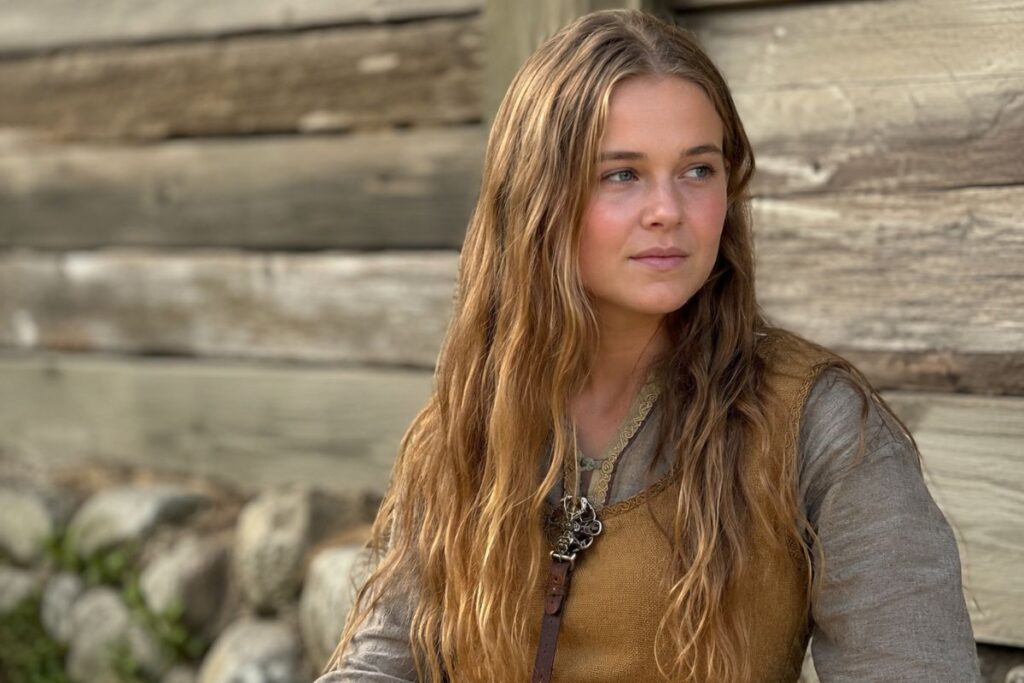
Long hair worn completely loose, with its natural texture left alone, is the simplest look on this list. Long, well-kept hair is well supported for Viking Age women. But the surviving figures more often show it gathered at the back than hanging free.
Ponytail, High or Low
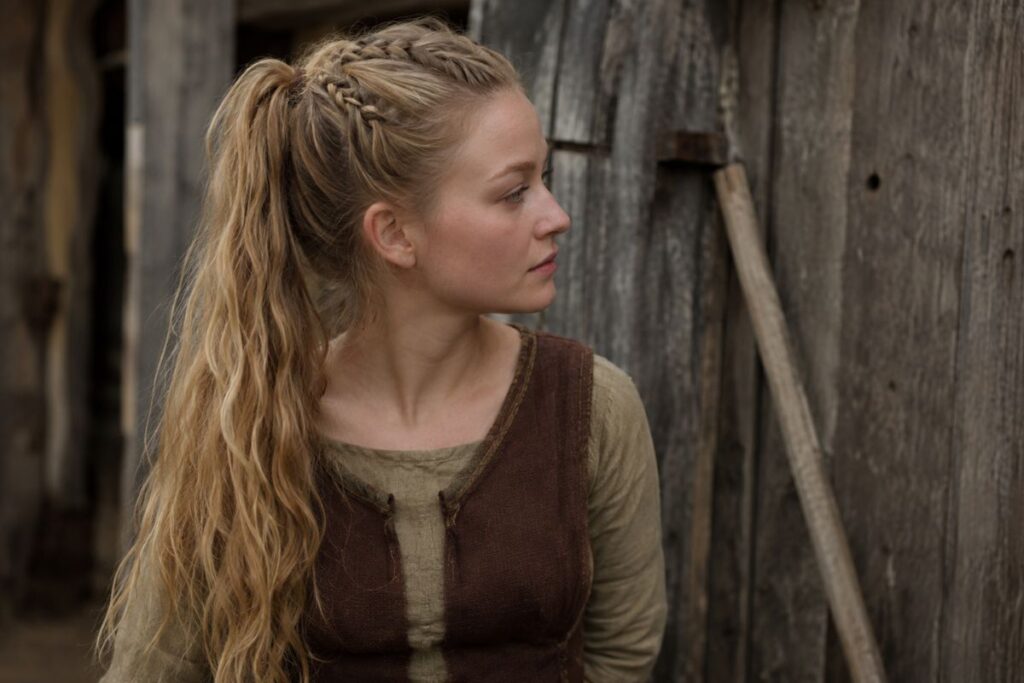
Gather the hair at the crown or nape and let the length hang free. Small Viking Age figures, such as the Hårby valkyrie, show a knot at the back of the head with the length falling behind it. That makes this one of the better-supported options here.
Bob Cut
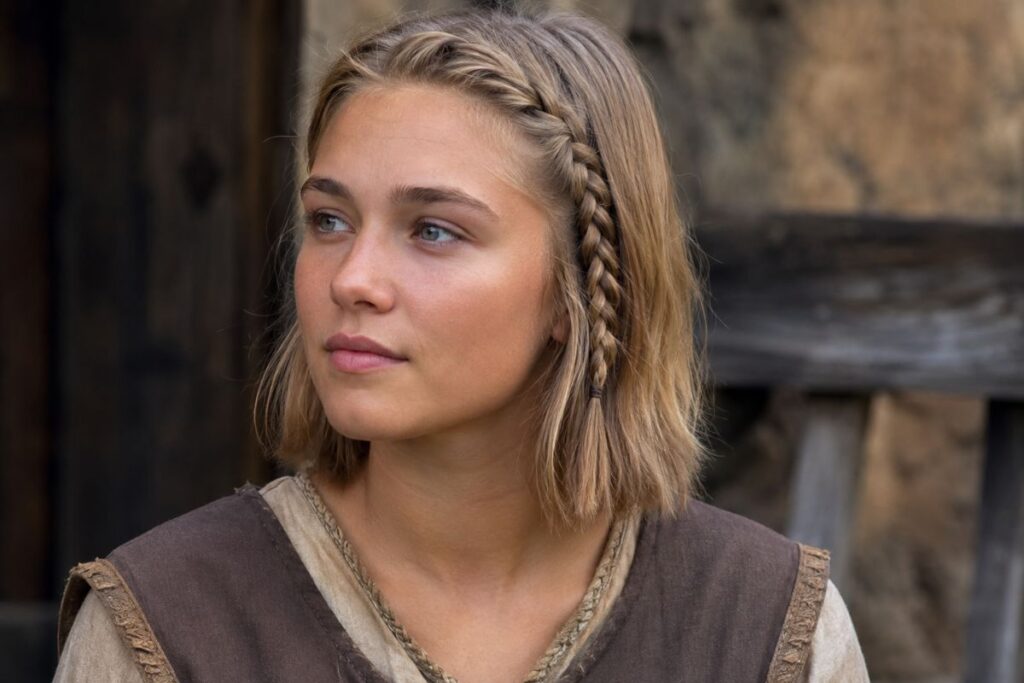
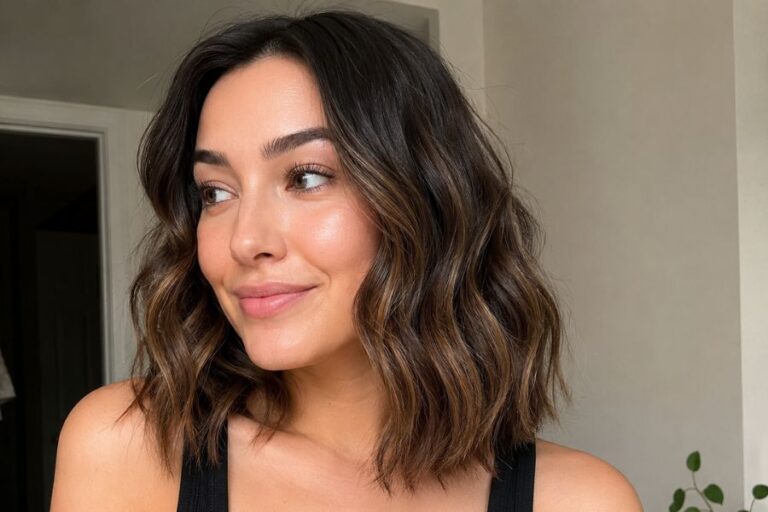
A shorter, even-length cut with no fringe is a modern option, not a historical one. It suits anyone who finds long hair hard to grow or care for. Small side braids near the temple still give it a Viking-inspired accent.
Simple Low Bun
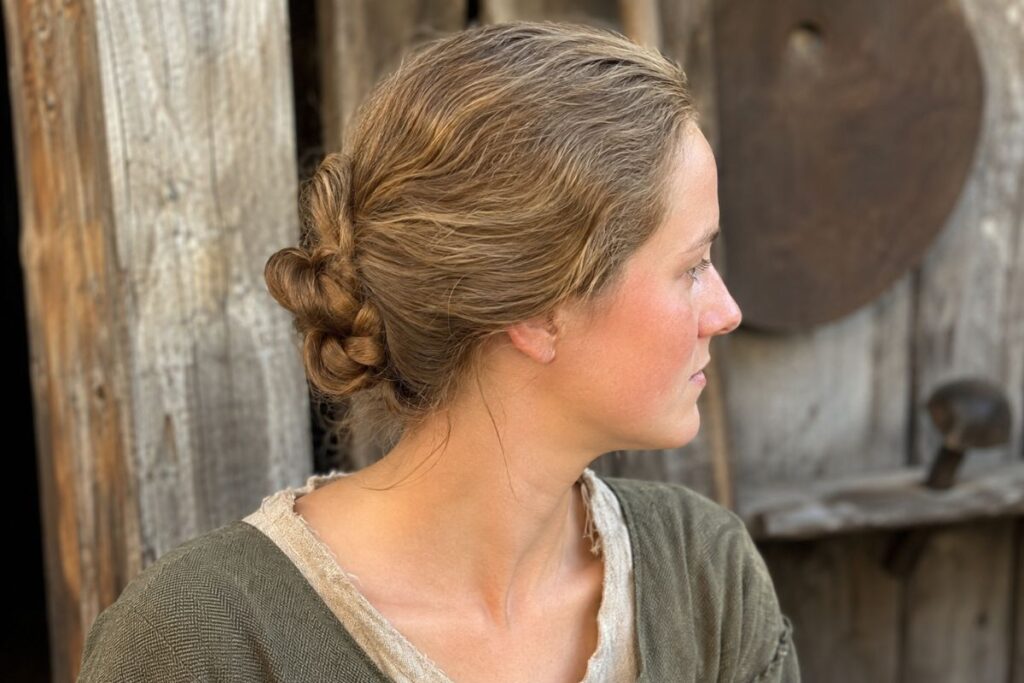
Hair gathered and knotted low at the back of the head is close to what the small Viking Age figures show. One example is the swept-back bun on the Revninge figure covered earlier. That figure probably depicts a deity, so it shows an ideal look rather than an everyday portrait.
Central Braid
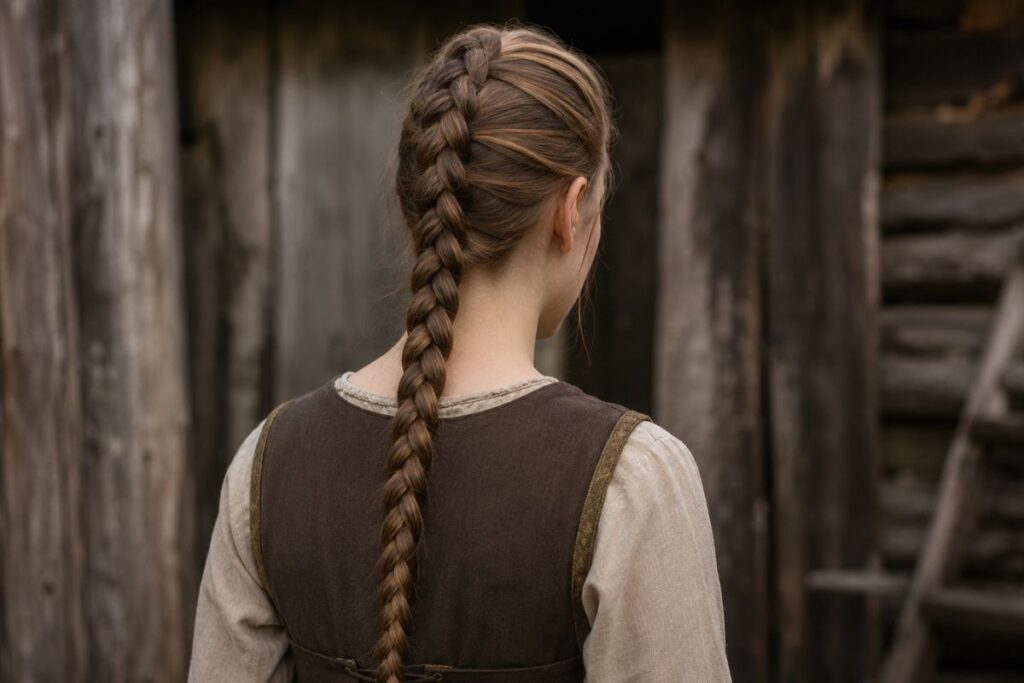
A single, tight three-strand braid running from the crown down the back of the head is easy to wear and practical for long hair. Braids are a reasonable guess for the period, although surviving images make knots and ponytails easier to confirm.
Shield Maiden Braid
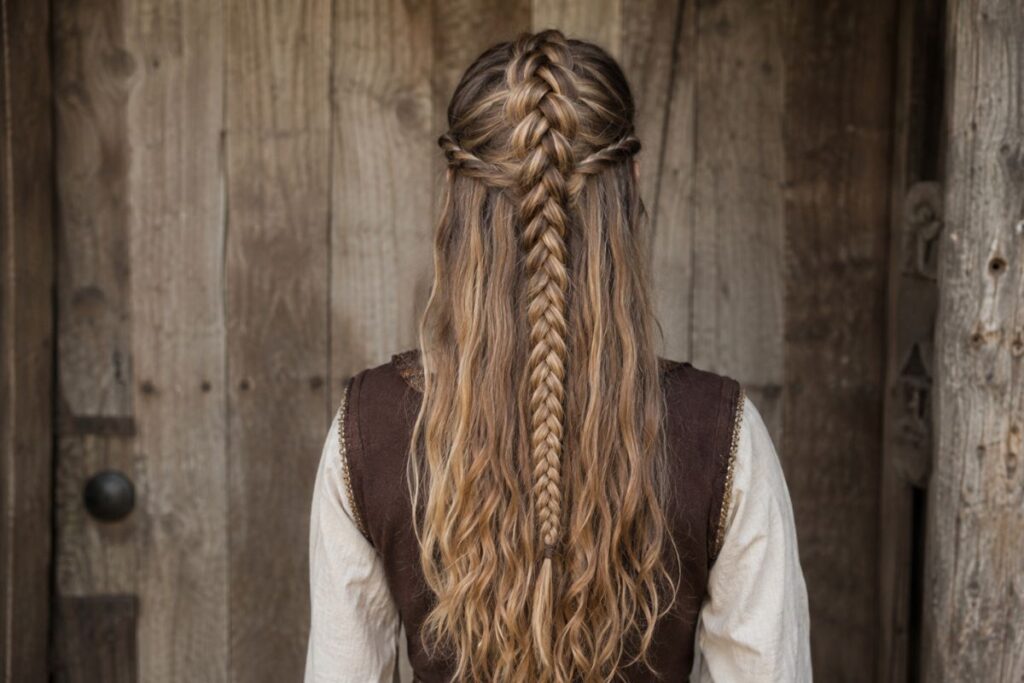
This tighter version of the central braid picks up small side sections as it works down the head. The full method is in the step-by-step section below. The name is a modern label rather than a historical one.
Two Braids
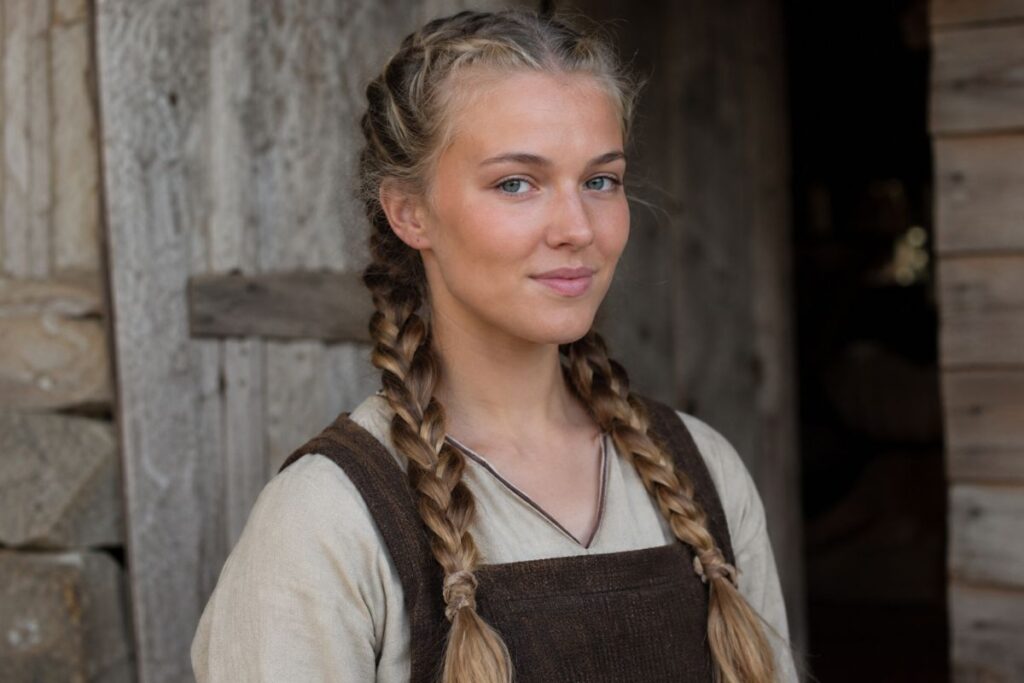
Divide the hair into two braids and wear them forward over each shoulder or down the back. Thicker hair gives each braid more body, so this one suits dense hair especially well.
Half Up, Half Down Braid
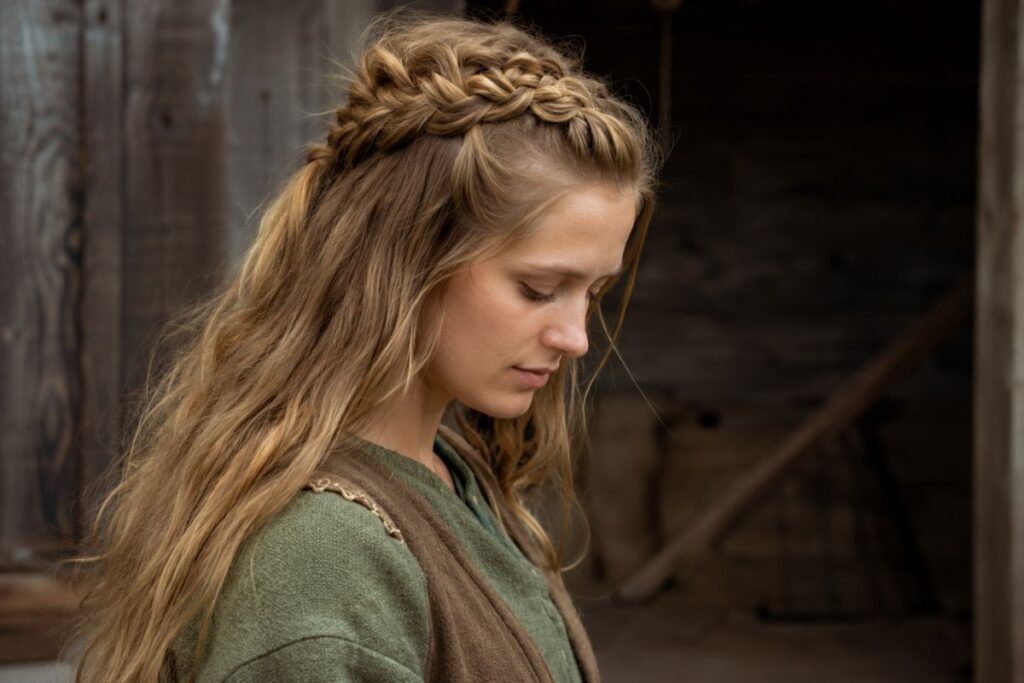
Gather the top section of hair into a braid or ponytail and leave the rest loose below for a softer alternative to a full updo.
Elegant Loose Braids and Curls
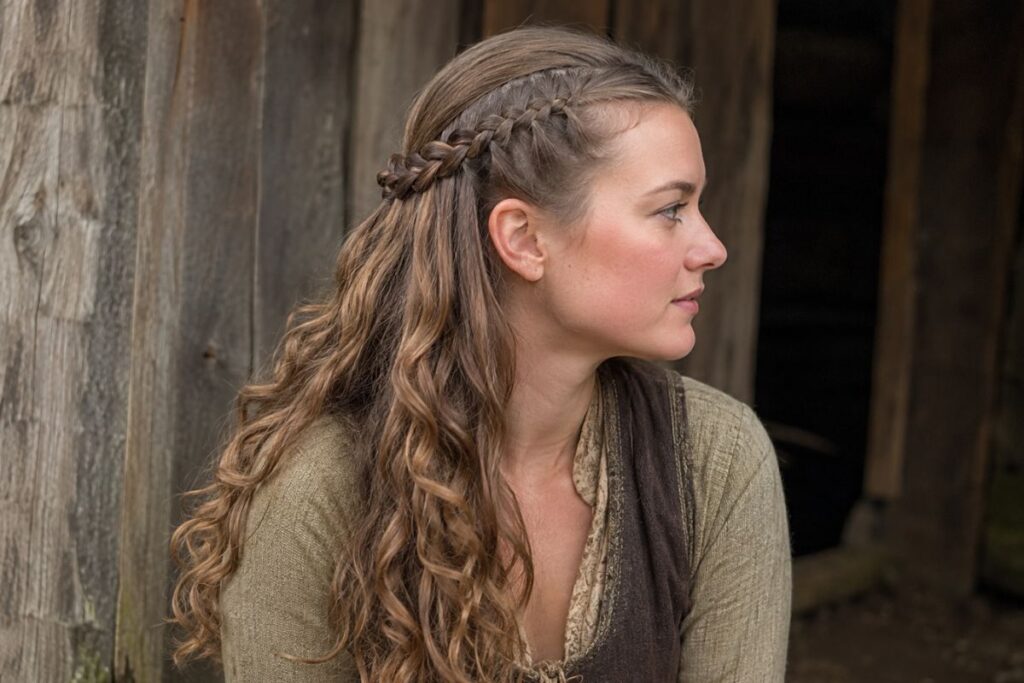
Take a small braid from each temple and join them at the back, then leave the remaining hair curled and loose. Combining the two techniques gives a softer, more romantic finish.
Loose Braid
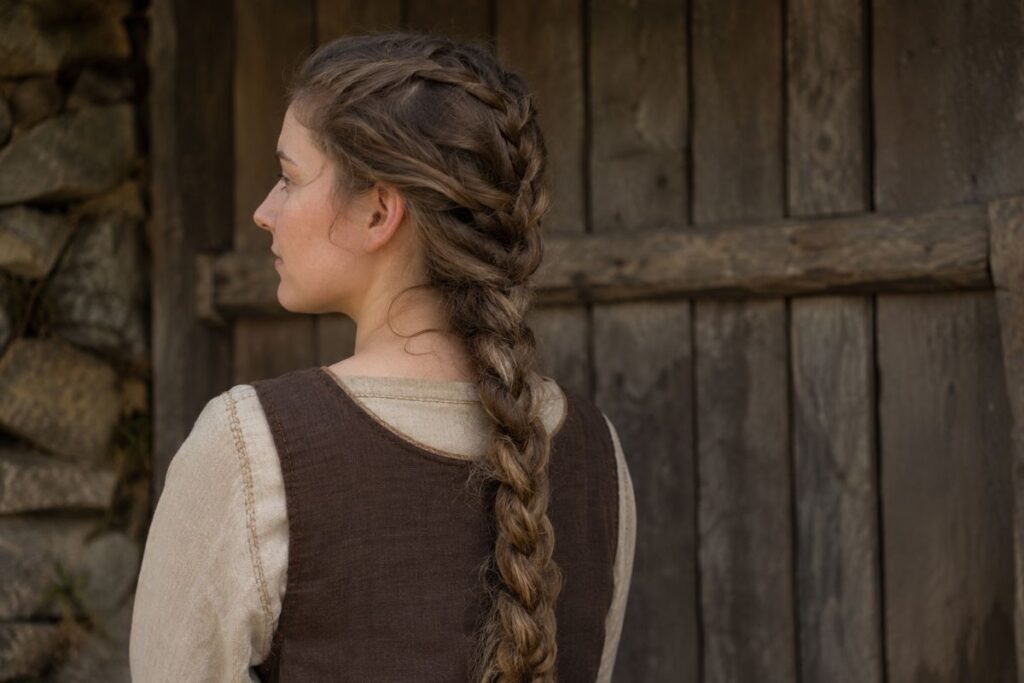
A relaxed, less tightly woven braid suits casual occasions better than a long active day, since a loose braid tends to slip sooner.
Curls on the Side
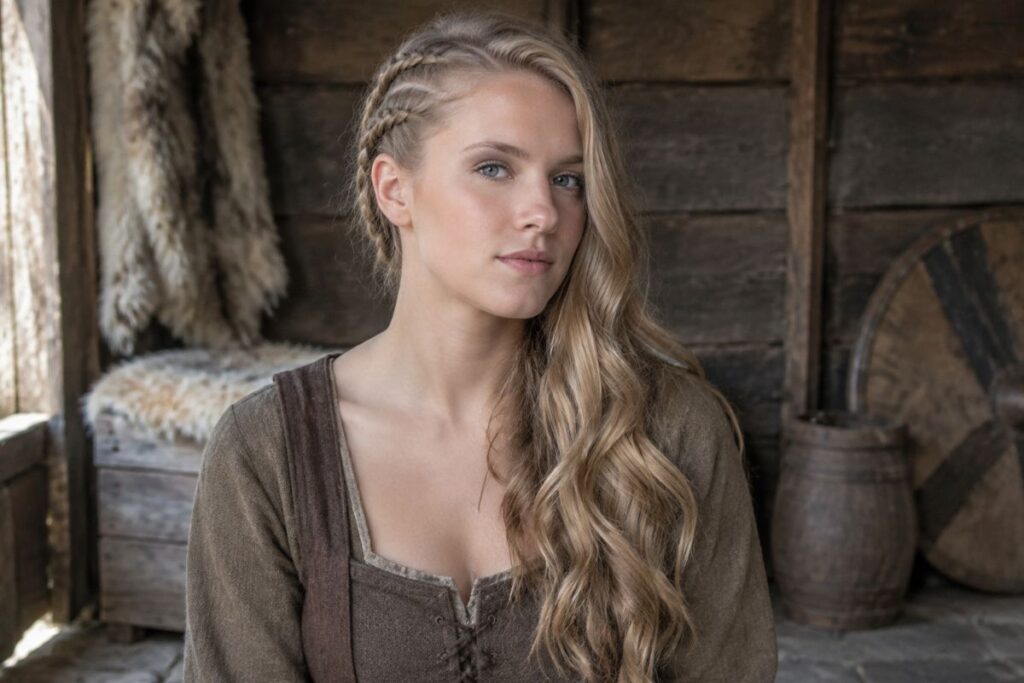
Sweep all the hair to one side and wear it loose or lightly curled for a modern styling choice with more drama than historical basis.
Braids on the Side
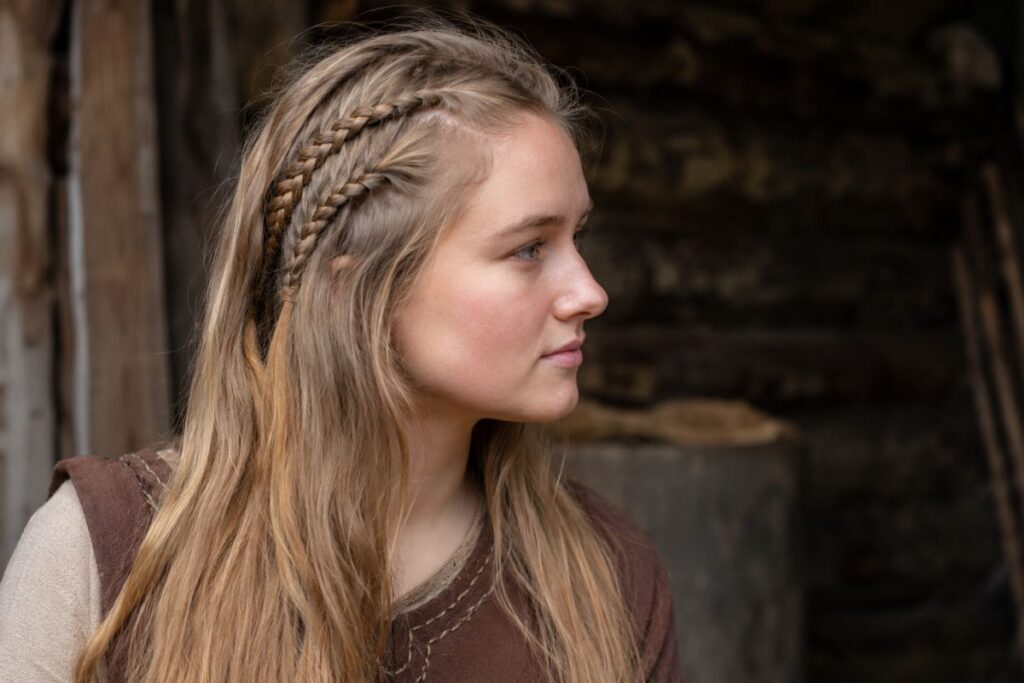
Two or more small, tight braids run along one side of the head near the temple. The rest of the hair stays loose or is gathered on its own.
Dutch Braids
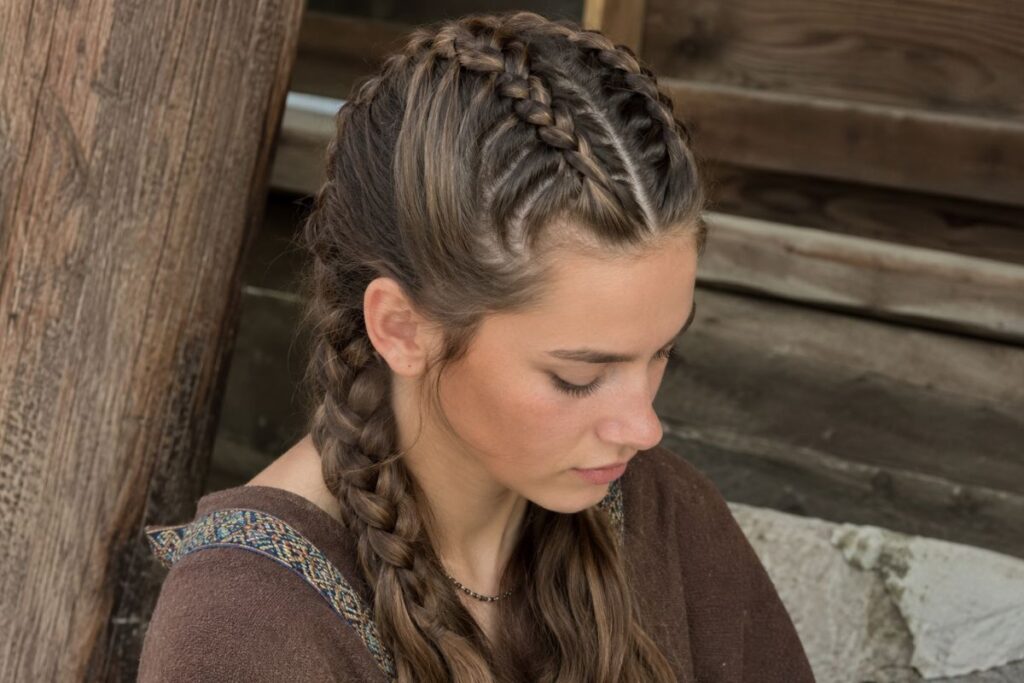
Because each section crosses under rather than over, Dutch braids sit raised and stand out against the scalp. The technique is modern and gives a bold, structured look.
Fishtail and Dutch Braid Combo
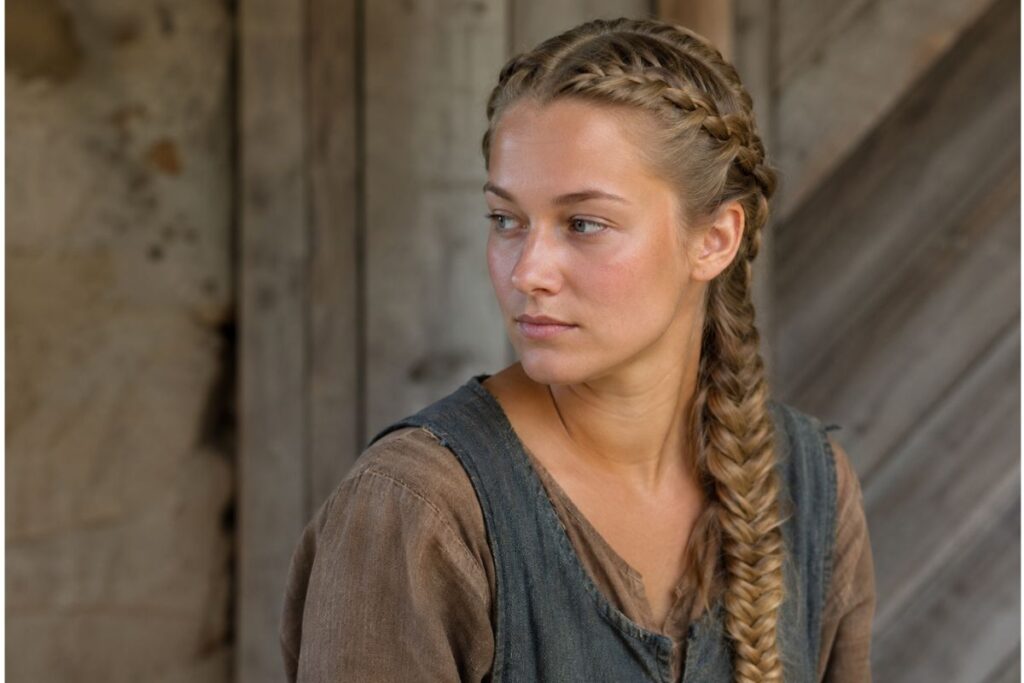
Start two Dutch braids at the front and secure them behind each ear, then work the remaining hair into a single fishtail braid. It takes longer than most styles here and is a modern combination rather than a historical one.
Braided Back
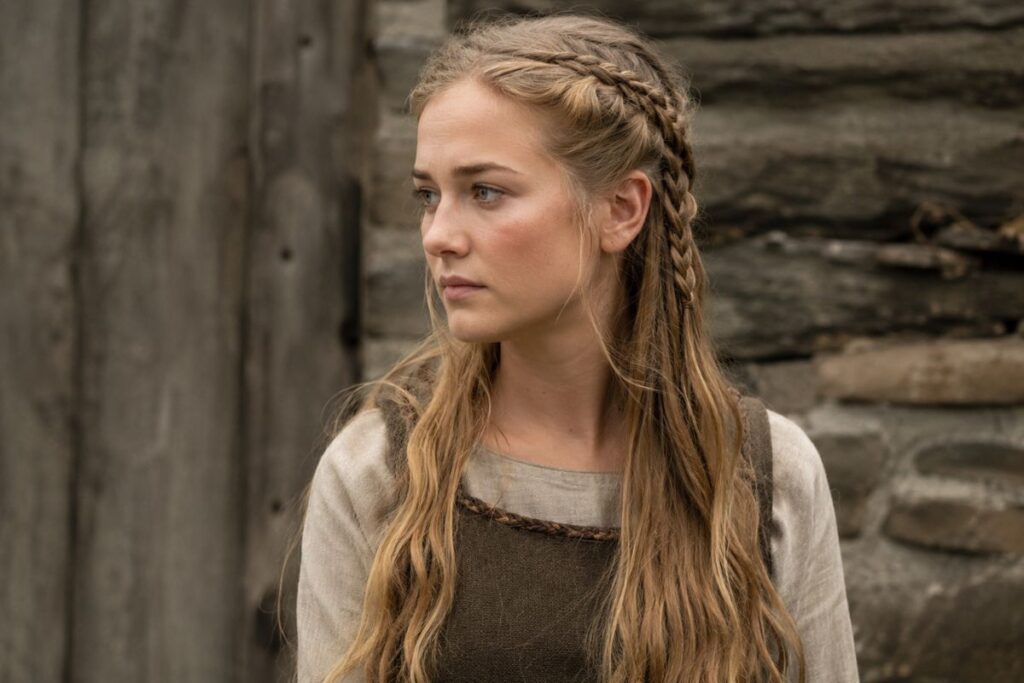
Thin braids along the sides or crown merge into loose hair below. This is the basic shape behind Lagertha’s look on screen, covered in the Lagertha section above.
Buzzed Side With Braids
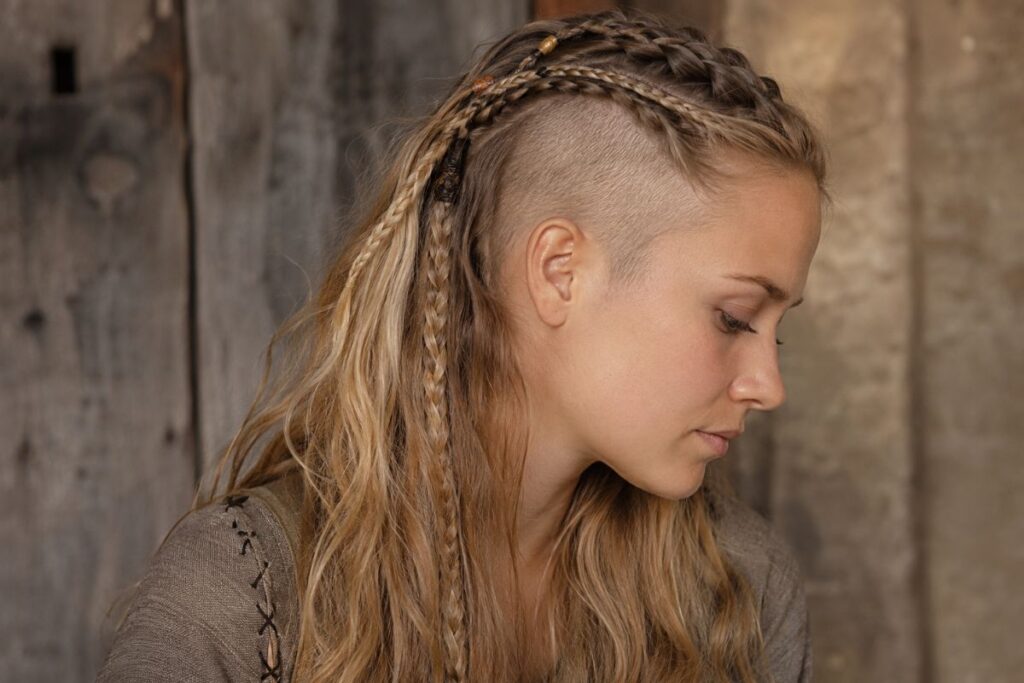
Shave or buzz one side of the head and braid the remaining hair. It is the boldest option here and the one most clearly taken from TV. Treat it as a modern look with Viking styling, not a copy of the past.
Step-by-Step Viking Braid Techniques for Women
These three techniques give you real, wearable Viking-inspired styles. You can create them at home.
The Shield Maiden Braid, Step by Step
Step 1: Begin with hair that’s slightly damp. This makes each section easier to control while you work.
Step 2: Gather a section of hair at your hairline, rather than starting at the crown.
Step 3: Begin a standard three-strand braid, heading straight back from that section.
Step 4: As you reach each temple, add a small piece of hair from that side into the braid.
Step 5: Continue this pattern down toward the nape, picking up small sections from each side as you go.
Step 6: Finish with a secure elastic once you reach the base of your neck.
Dutch and French Braid Variations
The difference between Dutch and French braids comes down to one movement. In a Dutch braid each outer section crosses under the center strand, so the braid sits raised and stands out against the scalp. A French braid crosses each section over the center instead, which gives a flatter, more classic finish. Either one works as the base for a Viking-inspired look, especially with a couple of small accent braids woven in near the temples.
A Loose, Softer Half-Up Braid Option
Take a small section from each side near your temples and braid each one back toward the center of your head. Secure the two braids together at the back and let the rest of your hair fall loose. The result keeps hair off your face for casual wear without the structure a full braided style needs.
Female Viking Hairstyles by Hair Length and Type
Your hair length and texture matter here. They change which Viking-inspired styles will actually work best for you.
Long, Thick Hair: Elaborate Braid Options
Long, thick hair handles elaborate braiding well, so it can carry several smaller braids woven into one larger central braid. The extra density keeps that layered pattern from looking sparse and helps it hold its shape for longer.
Short Hair and Bob Cuts: What Still Works
Short hair does not rule out a Viking-inspired look, because a single small braid along one side of the head, pinned back, still carries the idea. A small bead or a plain hair accessory near the braid finishes it without needing extra length. If your hair falls closer to your shoulders, our guide to shoulder-length hairstyles for women has cuts that leave enough length for a side braid.
Fine or Thin Hair: Avoiding a Sparse Look
Fine hair can look thin in a tight braid. Start with a looser braid and gently pull at its edges to make it look fuller. A half-up style is another good choice, since braiding only the top section adds structure without putting tension on all of your hair at once.
Accessorizing Your Viking Hairstyle
The right accessories can transform a simple braid. They turn it into a genuinely convincing Viking-inspired look.
Historical Accessories: What the Finds Support
Combs are the best-documented hair accessory from the Viking Age. As the comb research above shows, decorated combs were carried on the body, not left at home. Beads are well documented too, but as dress jewelry rather than hair jewelry. In one well-preserved set studied by the University of Stavanger’s Museum of Archaeology, the beads hung like a chain between two oval brooches. Those brooches held up an apron dress, a common style for women at the time. Many costume guides show gold or silver rings in women’s braids. No documented Viking Age find shows them, so treat them as a modern idea.
Modern Alternatives That Still Read as Authentic
Plain metal beads and leather cord for tying off braid ends are easy to find and simple enough to suit a period-inspired style. They are a modern touch rather than a reconstruction, since the beads in Viking Age finds were worn on dress strings, not in the hair. Simple, understated pieces generally look more convincing than a heavily decorated braid.
Frequently Asked Questions
What did female Viking hairstyles actually look like?
Long, well-kept hair was the norm. The clearest images, small silver figures from Denmark, show it gathered into a knot, bun or ponytail at the back of the head. Braids are plausible but harder to confirm, and the shaved-side styles seen on television have no support in the evidence.
Did Viking women really wear their hair in braids?
Probably some of the time, though the evidence is thinner than most costume guides suggest. Braids would have kept long hair secure during work, and thousands of decorated combs show that hair care mattered. On small figures, though, a braid is hard to tell apart from a scarf or cap. The shapes you can see clearly are knots and ponytails.
How do you do a shield maiden braid?
Start with slightly damp hair and begin a three-strand braid at the hairline, heading straight back. As you pass each temple, add a small piece of hair from that side. Keep picking up small sections on both sides down to the nape, then tie the end with an elastic.
What is Lagertha’s hairstyle from Vikings called?
The look has no historical name and is usually described as side braids with loose hair below, or simply a braided-back style. Its basic shape, with hair kept off the face and the length hanging free, fits the evidence, but the exact braid pattern is costume design.
Can you do Viking hairstyles with short hair?
A single small braid along one side of your head is enough to capture the look. Add a small bead or accessory near the braid. This enhances the effect. You do not need extra length for it to work.
Is the Viking hairstyle on TV historically accurate?
Some elements are, and some are not. Long hair and simple braiding are well supported by real evidence. Fully shaved sides paired with elaborate braided patterns are different, though. Those have no direct archaeological support.
Which Viking-inspired braids work best on fine hair?
For a festival or a long day, try a loose braid with its edges gently pulled out. It looks fuller than a tight one and puts less strain on fine hair. A half-up braid is the other safe choice, since only the top section is braided. Small accent braids at the temples add detail without needing much volume.
What the Evidence Still Cannot Tell Us
The gaps are as useful to know as the finds. Nobody can yet say how often Viking Age women braided their hair. The surviving figures are tiny, and the clearest ones show goddesses and valkyries, not ordinary women. It is also unclear whether women were expected to cover their hair. And no one knows for sure why some wore costly silk headscarves in towns like York and Dublin. Most of the written sources were set down after the Viking Age had ended.
What holds up is smaller but solid. Women had long, well-kept hair, often gathered at the back of the head, and people carried decorated combs and were buried with them. Any style in this guide that starts from that base can be worn with confidence about its roots. Anything beyond it is a modern choice, which is a perfectly good reason to wear it.

One Comment